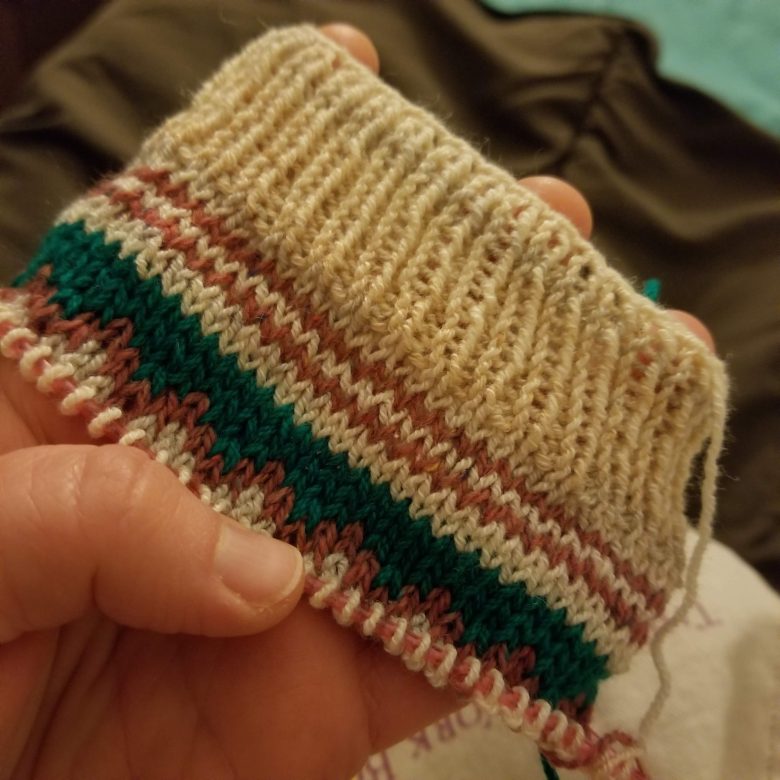
Colorwork is a beautiful option for knitters, it can bring so much joy to create a personalized project with colors or pictures that have special meaning to you or your recipient. Without adding complicated stitches, it can also bring a really striking look to your projects.
Knitting with multiple colors can help you make anything from Scandinavian sweaters (using Fair Isle knitting) to geometric shawls (which can use various techniques including mosaic knitting, stranded knitting and intarsia knitting).
Learning this new skill and knitting technique can open up whole new worlds of knitting. Allowing you to tackle new patterns and even personalize designs with your own ideas.
And the good news is, you can take this one step at a time. You don’t have to master each technique in order to try one out. And if one feels overwhelming, try a different one that feels more comfortable.
Some knitters feel they are not coordinated enough for colorwork – but if you can knit, you can do colorwork. You don’t even need to be an advanced knitter to tackle colorwork. And you don’t have to be able to read charts. There are colorwork techniques that only require one color at a time, so it will be similar to changing skeins of yarn. Totally doable!
So, What Is Colorwork Knitting?
Using more than one color of yarn to create a pattern or design.
At its most basic: Two-color stripes.
Say a scarf where you have two skeins of yarn. You start with one color to cast on and knit your first two rows. Then switch to your second color of yarn, knit two rows. Switch to your first color of yarn and repeat until your scarf is as long as you’d like. First colorwork pattern done!
Colorwork is an umbrella term that includes several methods. Most people think of the more involved techniques when they talk about colorwork. These include:
- Mosaic knitting
- Stranded knitting
- Intarsia
- Duplicate stitch
- Slip stitch colorwork
- Brioche colorwork
Let’s break this down into the two main categories: those that use one color at a time and those that use more than one color in the same row.
Working One Color at a Time
Examples:
- Mosaic knitting
- Duplicate stitch
- Intarsia (one color per stitch, but multiple bobbins)
Benefits to these colorwork techniques include:
- Being great for beginners! Helps guide you from knitting with just one color into knitting with more than one color while still feeling very similar to your previous projects
- Less tangled yarn! Since you only knit with one color at a time, the two colors don’t get twisted around each other as easily or as often as the multi-color at a time colorwork techniques.
Working Multiple Colors in the Same Row
Examples:
- Stranded knitting
- Fair Isle
- Some slip stitch variations
- Brioche colorwork
Benefits to these colorwork techniques include:
- More design flexibility, allowing you to use more color to depict your design in the same row which can change the direction you can have your designs face or how realistic or true to the original they are.
- Continuous motifs, allowing you to adjust beyond the restrictions of one color at a time colorwork knitting techniques.
There are a few additional things to keep in mind as you dive into multi-color row colorwork.
Floats
First, floats – these are the lines of yarn on the wrong side of your project for the color you are not actively working with.
You want these to be “just right” – not too long, not too short. If they are too long you can get things caught in them (fingers, toes, hopes, dreams…). If they are too short you might not have enough give to get the knit item on and off and it can make your design harder to see.
Tension
Second, tension – how tight your knit and/or purl stitches are.
This will impact your floats. And it will impact both the fit of your garment and how clear your colorwork pattern is. In addition to your actual knitting, the weight of your yarns can impact tension. You’ll want to use yarns that are the same weight to keep the fabric flat and even.
Yarn Dominance
Third, yarn dominance – the colors you choose will need to contrast sufficiently to make your colorwork image “pop”.
One way to get a feel for this without having to do any knitting is to take a picture of your yarn options in black and white (or full color and change to black and white). If the colors looks like a very similar shade of gray, the colorwork motif will be hard to make out. If one looks more white and the other looks more black, you will have a good contrast that clearly shows your design.


Making a swatch is also a great option to get a sense of what your final project will look like. This also gives you all the other benefits of swatching including confirming your needles are a good fit for the drape and size you are going for.
Now let’s look at three major types of colorwork knitting
Mosaic Knitting
What is Mosaic Knitting?
This is the “next step” colorwork I often do with students after stripes. It is a form of slip stitch colorwork with very specific conventions. You only work with one color at a time, and you slip stitches to make the pattern.
Skill Level: Beginner
Great First Project: Mug cozy or coaster
Feeling more adventurous? Make a cowl or hat
Mosaic knitting generally uses a chart, even if you have never knit from a chart before, give it a try! It is a great baby step into chart reading since the only thing changing in a row is between slipping a knitting or purling (if working flat) and slipping a stitch.
Stranded Colorwork (Fair Isle-Style)
What is Stranded Knitting?
This is often what people envision when talking about knitting colorwork, specifically Nordic sweaters with colorful patterns around the yoke (top of the sweater around your neck).
For stranded colorwork, you’ll carry two or more yarns across each row. This is what requires you to have “floats” in the back – the color you are not actively knitting with is being carried or stretched across the wrong side of your project.


Making them too tight will cause the project to pucker and pull together.
Making them too loose can lead to snagging or getting caught on things.
It can help a lot to keep your stitches spread out evenly along the needle, if your stitches are bunched together tight floats are likely. If they are spread out too far loose floats are likely.
Take special care at any needle joins, particularly relevant when you are using DPNs for your project.
Many stranded colorwork patterns are referred to as Fair Isle, but not always correctly.
Fair Isle-style has some hallmark traits, namely only using 2 colors per row, having more geometric patterns that keep the floats short (generally less than six stitches before switching), and it is always knit in the round (though often uses steeks allowing the sweater to be cut and made into a cardigan).
In a Venn diagram, Fair Isle is a subset of stranded colorwork, so not all stranded colorwork is Fair Isle but all Fair Isle is stranded colorwork.
To knit stranded colorwork projects, you’ll need to manage at least two colors at a time, but you will only pull one color at a time through any given stitch. You can manage your yarn in a variety of ways, including:
- Combination knitting: holding one yarn in your left hand and one in your right
- A knitting ring: created to hold more than one color at a time with the ring on either hand allowing your to “pluck” the desired color for each stitch
- Dropping and picking up: simply holding only the yarn you are actively working and then dropping it and picking up the next color when you are ready to switch
Whatever method you choose, you’ll want to regularly adjust and untwist your yarn so you don’t end up spending more time untangling knotted yarn than knitting.
Skill Level: Intermediate
Great First Project: Hat or cowl
Feeling more adventurous? Cast on a pair of mittens or the yoke of a sweater
Intarsia
What is Intarsia?
Unlike Mosaic or Stranded colorwork that alternate between colors along an entire row, Intarsia is used when there is an image or pattern that shows up just in one part of the project.
Like the letter rompers from Harry Potter, the majority of the sweater is the same color, but the recipients initial is in a different color (though, this may just as likely have been done with Duplicate stitch, but that is a topic for another day!)
Or if you want to add a mascot to a hat, that is a great example of Intarsia.
One benefit of Intarsia is no floats carried along the wrong side of the project. Instead, you use “bobbins” of colors. Bobbins are often plastic notions you can wrap small amounts of each color around. Some people also just use small balls.
The various colors’ bobbins will hang on the wrong side of your project waiting for you to come back to it to switch. In that sense it is like Mosaic knitting, where you switch when you come back to the color (but unlike Mosaic, you can switch one or more stitches before or after the bobbin depending on the design.
When joining, or switching, the yarns it is very important to twist the yarns around each other so you don’t end up with holes at each join.
Intarsia works great for adding animals, landscapes, letters or any picture to your knitting.


There are no long floats, so it also doesn’t have the same concern around catching fingers or toes. And your project will be the same thickness as if you knit it all with the same yarn since there is no doubling up.
However, it often leads to having lots of yarn ends to weave in at the end of your project. And it can be tricky to manage all the color bobbins.
Unlike Stranded Colorwork, Intarsia is best worked flat, so best for things that are flat like scarves or for pieced sweaters that will be sewn together once completed.
Skill Level: Intermediate
Great First Project: Hat or cowl
Feeling more adventurous? Add more detail/ colors or cast on a sweater
Intro to Colorwork Wrap-up
As shown by looking at these three colorwork techniques, colorwork is not a single skill, but a whole family of techniques. That means there is something for everyone, and as you continue to grow in your confidence and skill there will be more to explore and enjoy!
If you are brand-new to colorwork, choose a beginner-friendly project, something that is smaller and has less colors involved. Use that project to learn and get your feet underneath you. Then you can build from there and take a step into another, more involved project.
Remember, even the most experienced knitters started with just the basics. And each project is done just one stitch at a time.
Want a suggestion? Do a Mosaic coaster using the pattern from Interweave: https://www.interweave.com/article/knitting/tech-tip-mosaic-knitting/


